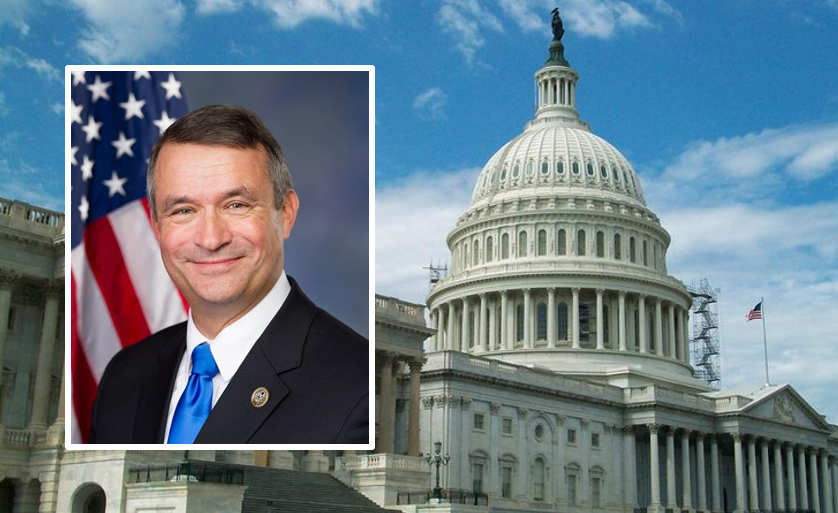
Nebraska's U.S. House delegation is split over a Republican-led bill that would give undocumented farmworkers already in the country temporary legal status and expand the H-2A guest worker program. Two of the state's three House Republicans co-sponsored the bill — one has since backed out.
The Securing Agriculture's Workforce Act was introduced June 30 by House Agriculture Committee Chairman Glenn Thompson, a Republican from Pennsylvania. Nebraska Reps. Don Bacon and Mike Flood both signed on as original cosponsors. Rep. Adrian Smith, a Republican representing Nebraska's 3rd congressional district, did not sign on as a cosponsor.
What the bill does
The legislation would let agricultural workers who are in the country illegally, but who can show a history of farm or ranch labor, apply for H-2A visa status. It would also expand H-2A eligibility to year-round agricultural operations for the first time and streamline the program's application process.
As of publication, the bill had 51 official cosponsors: 47 Republicans and four Democrats. Flood's name is still on the legislation, as he will not be able to officially withdraw his signature until the House returns to session Aug. 31
Bacon on the defense
In an interview with Nebraska Public Media News, Bacon said the legislation is the first significant reform to agricultural guest worker visas in decades and pointed to labor shortage estimates as the driving force behind it.
"GT Thompson — he's the chairman of the Agriculture Committee, Republican for Pennsylvania — put this bill together. His reasoning is it's been decades since we've done any reforms to these agriculture visas... they're only about one fourth of the need that's out there," Bacon said.
Bacon’s office did not respond by the time of publication for verification of that number.
Under the bill, Bacon said, the number of available agricultural visas would roughly quadruple, from about 100,000 to 400,000.
Bacon pushed back directly on critics who have called the bill amnesty, many of them Nebraska farmers and ranchers on social media.
"They can get a visa, and now they're legal, but it's not a permanent visa. And on top of that, it provides no pathway to citizenship… that's the mark of amnesty," Bacon said. "Folks yell 'amnesty' all the time on everything. But we're not offering a pathway to citizenship or anything like that. And actually, we get them in the system."
He also disputed comparisons circulating on social media likening the bill to slavery, saying workers would be guaranteed a living wage under the law that's written into H-2A wage requirements.
When asked about the online backlash, Bacon characterized it as coming from a vocal minority. He cited national polling showing a majority of Americans favor some legal pathway for undocumented immigrants already living and working in the country, short of mass deportation.
"I've been studying this stuff extensively for ten years. About 35% of the folks in America want to deport everybody that's been here illegally... they're loud, they're aggressive. But two-thirds of Americans roughly want secure borders, want dangerous people deported or those who aren't working, but they want something better than just deporting everybody," Bacon said.
A July 2026 Gallup poll found 75% of Americans favor allowing immigrants living in the U.S. illegally the chance to become citizens if they meet certain requirements, with 58% opposed to deporting all undocumented immigrants back to their home country — figures in line with Bacon's characterization of not wanting to “deport everybody." Gallup's question asks about a full pathway to citizenship, a stronger provision than what's in H.R. 9535, which does not include a path to citizenship.
Flood withdraws his support
Flood announced Friday he is withdrawing as a cosponsor of the bill. In a statement provided to Nebraska Public Media News by his office, Flood said he wants to find a different way to address labor issues hurting farmers and ranchers.
"Concerns from constituents, conservative leaders and Nebraska ag producers have made clear that provisions in the Securing America's Workforce Act are not the right way to uphold our immigration laws," Flood said. "I'm listening, and at a moment when our border is finally secure thanks to President Trump's leadership, I'm not willing to move forward on anything that could risk our progress. I will be removing myself as a cosponsor and working toward an alternative to address this issue for farmers and ranchers."
When asked about Flood's decision to withdraw, Bacon declined to criticize his fellow Nebraska Republican.
"I'm not going to criticize him or say he's wrong. He's going to do what he thinks is right," Bacon said.
Discussing the bill's broader prospects in the House, Bacon said that if it came to a vote today, "it would probably pass."
Smith also opposes the bill
Flood isn't the only House member against the bill. Smith, who wasn't an original cosponsor, said he does not support the bill in its current form.
Smith's office confirmed to Nebraska Public Media News that he does not support the bill, citing concerns over the provision allowing individuals who entered the country illegally to apply for H-2A status. A spokesperson said Smith recognizes that agricultural operations across Nebraska have different needs and challenges, and that he will continue working to ensure producers have a variety of tools and resources available.
"I appreciate my colleagues' efforts to address challenges to labor for America's agriculture industry. Unfortunately, good intentions can have unintended consequences. As it is currently written, there is a provision that has the potential to reward illegal behavior, which I cannot support," Smith said.
With Flood withdrawing and Smith opposed, Bacon is now the only member of Nebraska's three-person U.S. House delegation still supporting the bill.
A dispute over who actually supports the bill
Bacon has said the bill has the backing of more than 520 agricultural organizations nationally, including about 20 from Nebraska. In a July 21 public reply on X to Nebraska rancher Casey Schuhmacher, a cow-calf and stocker producer in Nebraska's Panhandle who is critical of the bill, Bacon wrote: "You should talk to the NE FB [Nebraska Farm Bureau] and Cattlemen [Nebraska Cattlemen]. We don't have the workers to do what you want."
Neither organization appears by name among the Nebraska entries in the bill sponsors' published stakeholder-support documentation, though their national affiliates do.
Bacon said he personally spoke with the Nebraska Farm Bureau's president and confirmed the organization's support independently of the published list. He said Nebraska Cattlemen has not issued a formal position on the bill, but described the organization as "generally supportive."
Nebraska Farm Bureau told Nebraska Public Media News no one was available for an interview. Nebraska Cattlemen did not respond to a request for comment.